
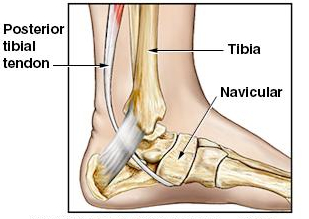
 The Navicular Bone acts as a key stone for the boney structures of the foot. When the bone gets pulled anterior (or towards the top of the foot), the spring mechanism of the foot is altered, leading to pain at the top of the foot.
Cause of a navicular stress
Stress to the navicular typically occurs over time with excessive weight bearing activity such as running, sprinting, jumping or dancing. They often occur following a recent increase in activity or change in training conditions (such as surface, footwear or technique changes etc).
.jpg)
Figure 1 – Relevant Anatomy of a Navicular Stress Fracture
.jpg)
Figure 2 – Navicular Anatomy (right foot)
Contributing factors to the development of a navicular stress
There are several factors which may contribute to the development of this condition. These need to be assessed and corrected. Some of these factors include:
- inappropriate or excessive training or activity (particularly on hard or uneven surfaces)
- inadequate recovery periods from training or activity
- poor foot posture (especially flat feet or high arches)
- poor biomechanics
- muscle weakness (particularly of the gluteals, quadriceps, calf and core stabilisers)
- muscle fatigue
- poor balance
- poor flexibility (particularly of the calf muscles)
- joint stiffness (particularly of the ankle, heel or foot)
- inappropriate footwear
- poor running technique
- inadequate diet
- leg length discrepancies
- being overweight
- menstrual disturbances
Manual medicine for a navicular over-stress problem
In individuals with this condition, it is vital in to hasten healing, prevent injury recurrence and ensure an optimal outcome. Treatment may comprise of:
- soft tissue massage
- joint mobilization
- joint manipulation
- activity modification advice
- arch support taping
- biomechanical correction (e.g. the use of orthotics)
- technique correction
- footwear advice
- exercises to improve strength, balance, flexibility and core stability
- a gradual return to running / activity plan
Exercises for a navicular issue
The exercises below should be performed 2 – 3 times daily only provided they do not cause or increase symptoms.
Initial Exercises
Foot & Ankle Up & Down
Move your foot and ankle up and down as far as you can go without pain and provided you feel no more than a mild to moderate stretch (figure 3). Repeat 10 – 20 times provided there is no increase in symptoms.
.jpg)
Figure 3 – Foot & Ankle Up & Down (left foot)
Foot & Ankle In & Out
Move your foot and ankle in and out as far as you can go without pain and provided you feel no more than a mild to moderate stretch (figure 4). Repeat 10 – 20 times provided there is no increase in symptoms.
.jpg)
Figure 4 – Foot & Ankle In & Out (right foot)
Foot and Ankle Circles
Move your foot and ankle in a circle as large as you can go without pain and provided you feel no more than a mild to moderate stretch (figure 5). Repeat 10 – 20 times in both clockwise and anticlockwise directions provided there is no increase in symptoms.
.jpg)
Figure 5 – Foot & Ankle Circles
If you have any questions, feel free to email me at drshepard@bnchiro.com